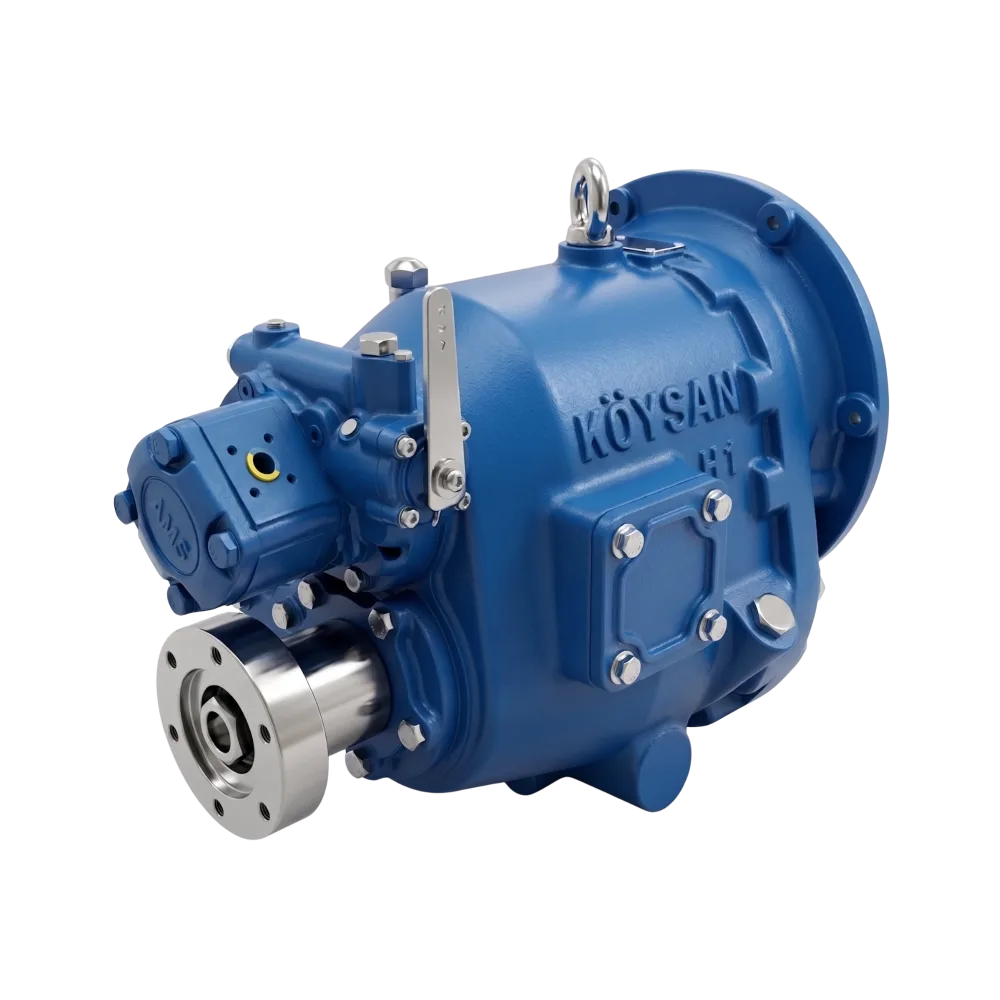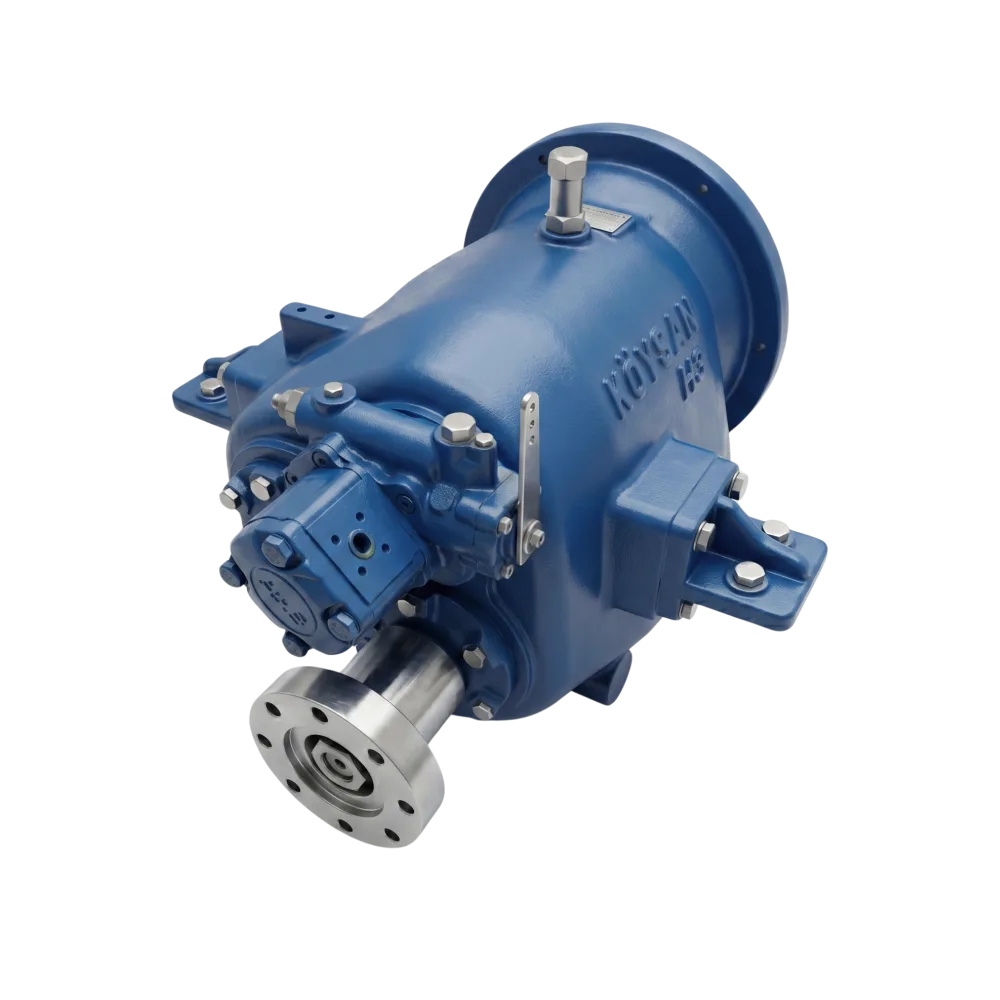
Technical Guide
How to Choose the Right Reduction Ratio?
Learn how to select the correct marine gearbox reduction ratio for your boat by matching engine power, RPM, and propeller diameter.
Short Answer
The reduction ratio is the coefficient that reduces the high RPM (revolutions per minute) of the engine to a lower RPM where the propeller can push water most efficiently. The correct ratio is determined by your engine's maximum RPM, your boat's usage profile (speed vs. thrust), and the maximum propeller diameter that can physically fit under the hull. Choosing the wrong reduction ratio will overwork the engine, prevent the boat from reaching its target speed, and dramatically increase fuel consumption.
Matching Core Components: The Engine and Propeller Paradox
There is a fundamental engineering rule in marine propulsion systems: Internal combustion engines like to produce maximum power at high RPMs, while propellers push water much more efficiently at low RPMs.
If we were to connect an engine directly to a propeller without a marine gearbox, the high-spinning propeller would cause "cavitation" (creating air bubbles in the water and spinning freely) without actually pushing the water. The reduction ratio of the gearbox reconciles these two opposing characteristics. For example, a gearbox with a 2:1 (two-to-one) ratio turns the propeller shaft 1 full revolution for every 2 revolutions of the engine crankshaft. This increases torque (turning force) while dropping the RPM into the propeller's optimal range.
3 Main Factors Influencing Your Choice
1. Maximum Engine RPM
Every engine has a characteristic RPM range. A high-revving light-duty marine engine (e.g., 3000-3500 RPM) and a low-revving heavy-duty commercial engine (e.g., 1800 RPM) require completely different reduction ratios. As a general rule, the target propeller shaft speed is between 1000 and 1500 RPM, depending on the vessel type. The reduction ratio is the divisor that brings your engine's maximum RPM down to this optimum range.
2. Boat Usage Profile (Speed vs. Thrust)
What do you want your boat to do in the water? This question is the most critical crossroads in gearbox selection.
- Speed and Pleasure Craft (Light Duty): For boats that travel by planing over the water, water resistance is relatively low. Lower reduction ratios (e.g., 1.5:1 or 2:1) are preferred. The propeller spins relatively fast, allowing the boat to accelerate quickly.
- Fishing Boats, Tugs, and Workboats (Heavy Duty): For displacement hulls that pull heavy loads, high torque (thrust/pulling power) is essential rather than speed. Therefore, higher reduction ratios (e.g., 3:1, 4:1, or 5:1) are required. The shaft spins slowly but turns the propeller with unstoppable force.
3. Propeller Diameter and Hull Clearance
According to the laws of physics, if you slow down the propeller by choosing a high reduction ratio, you must increase the propeller's surface area (diameter) to compensate for the loss of thrust. This is where the biggest physical obstacle arises: Propeller clearance. If the distance between your boat's hull bottom and the shaft axis does not allow for a large propeller, you cannot use a high reduction ratio, even if it works in theory. Having the propeller blades too close to the hull causes excessive vibration and noise.
| Application Type | Characteristics | Ideal Shaft RPM | Common Ratios |
|---|---|---|---|
| Fast Cruisers / Speedboats | High shaft RPM, small diameter propeller, low torque | 1500 - 2000 RPM | 1.5:1 – 2.5:1 |
| Passenger / Crew Boats | Balanced RPM and torque, medium propeller | 1200 - 1500 RPM | 2.5:1 – 3.5:1 |
| Tugs / Trawlers | Low shaft RPM, very large propeller, maximum torque | 800 - 1200 RPM | 3.5:1 – 5:1+ |
Example Calculation Scenarios
To make it clearer, let's look at two different types of boats:
Scenario A: 12-Meter Pleasure Craft (Motor Yacht)
- Engine: 320 HP @ 2800 RPM
- Goal: Fast cruising, low vibration.
- Selection: 2:1 reduction ratio.
- Result: The propeller shaft turns at a maximum of 1400 RPM (2800/2). With a propeller that is relatively small in diameter but high in pitch, the boat easily reaches its target speed.
Scenario B: 15-Meter Wooden Fishing Boat
- Engine: 320 HP @ 2100 RPM (Same power, different RPM characteristic)
- Goal: Maximum thrust (bollard pull) while towing nets full of fish.
- Selection: 3.5:1 or 4:1 reduction ratio.
- Result: The propeller shaft turns at only 600 RPM (2100/3.5). Massive torque is transferred to the shaft, and maximum thrust is achieved with a giant propeller that fits under the hull.
3 Common Mistakes in Gearbox Selection
Frequently Asked Questions
Can I change the reduction ratio of my existing gearbox later?
In practice, no. The gear sets (pinion and gear wheel) inside the gearbox are machined with high precision for specific ratios, and the housing's center distance is calibrated accordingly. Changing the ratio means mechanically buying a new gearbox housing/gear set and hydrodynamically buying a new propeller. It is usually much safer and more economical to buy a new gearbox.
My engine RPM is 3000, and my propeller RPM should be 1500. Should I get an exact 2.00:1 ratio?
In engineering, exact whole numbers (2.00:1, 3.00:1) are generally not preferred due to gear wear. You will often see "fractional" ratios in catalogs, such as 1.96:1 or 2.04:1. This prevents the exact same teeth from constantly meshing with each other (a concept known as "hunting tooth") and extends the life of the gearbox. You can treat these fractional ratios as whole numbers when making your selection.